13-24 of 154 results

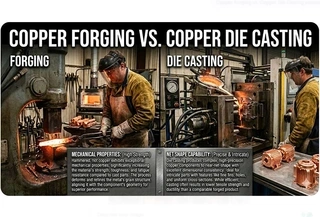
Copper Forging vs. Copper Die Casting: What's the Difference

This article provides a comprehensive guide to copper forging and copper die casting, covering the full manufacturing process from raw material selection to finished product. It details step-by-step workflows, technical features, advantages and disadvantages, material choices, heat treatment, and quality control methods for both processes. By comparing performance characteristics, production suitability, and cost considerations, the guide helps manufacturers, engineers, and buyers make informed decisions about which copper processing method best meets their industrial needs, ensuring high precision, durability, and performance.

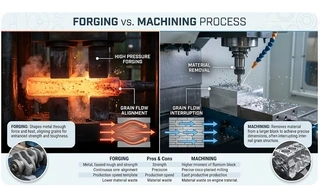
Forging vs. Machining: How to Optimize Cost and Performance

This comprehensive guide explores forging and machining, two key metal forming processes in modern manufacturing. It covers process principles, performance characteristics, cost efficiency, and application scenarios, comparing strength, precision, material utilization, surface quality, and production timelines. The article also discusses hybrid approaches combining forging and machining to optimize both mechanical performance and dimensional accuracy. Practical decision frameworks for process selection across industries such as automotive, aerospace, energy, and heavy machinery are provided, helping manufacturers balance cost, quality, and reliability.

What is Forged Valve Manufacturing Process

This article provides a detailed analysis of forged valve manufacturing, covering material selection, forging methods, heat treatment, precision machining, surface treatment, assembly, and quality control. It explains how forging enhances mechanical strength, corrosion resistance, and reliability, making forged valves ideal for high-pressure, high-temperature, and corrosive environments in industries such as oil and gas, power generation, chemical processing, and marine engineering. The guide also highlights design considerations, key advantages, and best practices for supplier selection to ensure long-term performance and safety.

Understanding Carbon Steel Forging from the Guide

Carbon steel forging is a versatile and reliable metalworking process that transforms steel into high-strength, durable components through controlled heating and plastic deformation. By aligning grain flow and eliminating internal defects, forged parts achieve superior mechanical properties, including enhanced fatigue resistance, impact toughness, and structural integrity. With a wide range of carbon steel grades, from low to ultra-high carbon, this process supports diverse industrial applications, including automotive, oil and gas, heavy machinery, agricultural equipment, and hand tools. Combining cost-effectiveness, machinability, and long service life, carbon steel forging remains a preferred choice for critical load-bearing parts in modern manufacturing.

Guide to Metal Forging with Presses

This article provides a comprehensive overview of forging press technology, detailing its working principles, classifications, and industrial applications. It covers mechanical, hydraulic, screw, servo, pneumatic, and extrusion presses, as well as upright and C-frame designs, highlighting their operational features, advantages in material strength, production efficiency, and safety. The discussion also explores key applications across automotive, aerospace, heavy machinery, medical devices, construction, and coin manufacturing, and offers guidance on selecting the appropriate forging press for different production needs.

Role of Temperature Control in Metal Forging

Metal forging is a foundational manufacturing process where temperature plays a pivotal role in shaping metal and determining product quality. Precise temperature control enhances metal plasticity, prevents defects like cracks and grain coarsening, and ensures consistent mechanical properties. Modern forging relies on continuous monitoring using infrared thermometers, thermal imaging, and automated control systems to maintain optimal heating, forging, and post-forging heat treatment conditions. Proper temperature management not only improves product performance and consistency but also reduces energy consumption, minimizes downtime, and enables automation across industries such as automotive, aerospace, railway, and heavy machinery.

Challenges in High-Temperature Alloy Forging Process

High-temperature alloy forging is a critical advanced manufacturing process for aerospace, energy, and petrochemical applications, where materials must maintain exceptional strength, creep resistance, and corrosion resistance under extreme temperatures. This article examines the key technical challenges involved in heating control, deformation resistance, microstructure regulation, and process limitations caused by complex alloy compositions. It also introduces major forging technologies, including isothermal forging, rapid forging, powder metallurgy forging, and composite material forging, while emphasizing the importance of comprehensive quality assurance systems.

Analysis of Internal Stress in Forging Cooling Process

The cooling stage of forging plays a decisive role in determining final product quality, as improper cooling can generate complex internal stresses that lead to cracking and structural failure. This article systematically analyzes the formation mechanisms of temperature stress, structural stress, and residual stress during forging cooling, explaining their spatial distribution characteristics, evolution laws, and superposition effects. By comparing the behavior of soft steel and hard steel forgings, the study highlights the differences in crack risk between internal and surface regions. The paper further summarizes crack prevention principles and practical process control strategies, including cooling rate optimization, structural design improvement, and phase transformation management

Understanding Forging and Heat Treatment Cracks

This article provides a systematic comparison of forging cracks and heat treatment cracks, two common defects in metal processing, by examining their formation temperatures, mechanisms, microstructural characteristics, and root causes. It outlines practical metallographic identification methods to help technicians accurately distinguish between crack types during failure analysis and avoid misjudgment that could lead to improper process adjustments. The article also highlights key factors influencing crack formation and presents targeted preventive measures for forging, quenching, and grinding operations, enabling manufacturers to improve process control, reduce scrap rates, and enhance overall product quality and production efficiency.

Guide to Multi-Directional Die Forging Technology

Multi-directional die forging is an advanced metal forming process used to produce high-precision components with complex geometries. By applying pressure from multiple directions through specialized hydraulic presses and multi-part dies, the process enables superior metal flow, minimal flash, and excellent dimensional accuracy. This article explores the structural features of multi-directional forging equipment, the four primary die configurations, critical design considerations, material selection, billet pre-treatment methods, and solutions for deep-hole forgings.

Forging Ratio: A Key Parameter in the Forging Process

This section explains the concepts of drawing and upsetting forging ratios, presenting their definitions, text-based calculation formulas, and parameter meanings to clearly describe how metal deformation and compression are evaluated during the forging process and how these ratios serve as key indicators of forging quality.

Open-Die Forging Technology for Flange Manufacturing

Open-die forging of flanges is a traditional yet vital manufacturing process in modern industry, ensuring strong, precise, and reliable pipeline connections. This article details the complete forging workflow, including cutting, heating, upsetting, core drawing, and hole expansion, while highlighting critical quality control measures for billets, forging, and heat treatment. Optimization strategies such as improving billet quality, refining operation procedures, and strengthening inspection are discussed to enhance efficiency and product performance.

Total 154 Records, 12 records per page