
Metal forging is one of humanity's earliest mastered manufacturing processes and remains a critical, irreplaceable technology in modern industrial production. Simply put, forging is the process of shaping metal by applying external forces, typically through hammering or pressing. The production of automotive components, railway wheels, aircraft engine parts, and structural steel members all relies heavily on forging. At the heart of this process lies temperature. Metals become soft at high temperatures, allowing them to be shaped like dough. However, improper temperature control can either leave the metal too hard, causing cracks, or overheat it, degrading its material properties. This is why temperature monitoring equipment is as essential as the forging machinery itself in a workshop.
Forging can be broadly divided into two main types: hot forging and cold forging. Hot forging, the more common approach, requires heating the metal to elevated temperatures. Most steels are hot forged between 900°C and 1250°C (approximately 1650°F to 2280°F).
Different steels require distinct temperature ranges. Ordinary carbon steel typically forges best between 1200°C and 1450°C. Austenitic stainless steels demand higher temperatures, usually above 1038°C (1900°F). Alloy steels, with their complex chemical compositions, often require even higher temperatures and stricter heating control. High-alloy tool steels may sometimes need forging temperatures exceeding 1450°C.
Cold forging, by contrast, is carried out at or near room temperature. While it requires no heating, it demands greater force. Cold forging is suitable for certain smaller components, but most industrial forging is performed as hot forging.
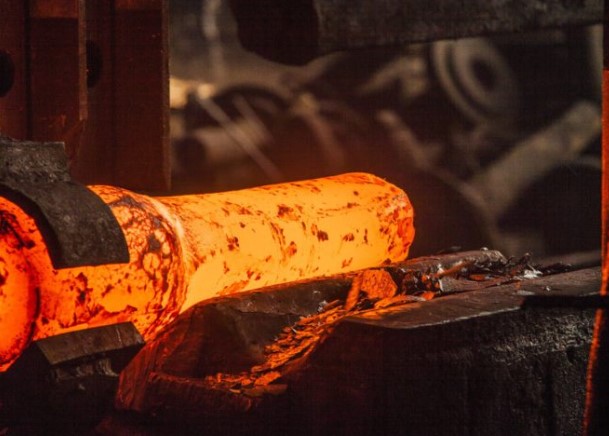
Temperature control is critical throughout the forging process, directly affecting both the deformability of metal and the quality of the finished product. Low temperatures make metals hard and prone to cracking, while excessively high temperatures can coarsen grain structure and degrade mechanical properties. Precise temperature management is key to preventing defects and ensuring consistency.
Metal plasticity refers to a material's ability to deform under stress without fracturing. Higher temperatures increase atomic activity within the metal, allowing the crystal lattice to slide more easily and making the material more malleable. This is why hot forging can more easily produce complex shapes than cold forging.
If the metal is too cold, its strength remains high, making deformation difficult. Forced forging can introduce internal cracks, and in severe cases, the metal may fracture outright during hammering. Such defects from low-temperature forging are often irreparable, leading to scrap.
Conversely, excessive temperatures are equally problematic. Prolonged exposure to high heat can cause grain growth, reducing strength and hardness. Surface oxidation may occur, forming scale, and defects such as internal porosity, surface folding, or delamination can arise.
Forging temperature directly impacts the mechanical properties of the finished product in three main ways:
- Grain size control: Temperature affects the size and morphology of grains in the metal. Excessive heat can lead to grain coarsening, reducing hardness and strength, while slightly lower temperatures can refine grains and improve overall properties. This explains why high-strength parts require strict final forging temperature control.
- Grain boundary distribution: At different temperatures, the position and number of grain boundaries change. Grain boundaries influence plasticity and toughness. Proper temperature control optimizes grain boundary distribution, enhancing performance.
- Phase transformation regulation: Many metals undergo phase changes during heating and cooling, such as solid solution transformations or precipitate formation. These transformations directly affect hardness and strength. Precise temperature control enables regulation of these processes to achieve the desired microstructure.
Modern forging is not simply heating metal and striking it; it is a highly controlled process requiring continuous temperature monitoring.
Before placing billets into the furnace, the furnace itself must be preheated to ensure uniform temperature distribution and prevent localized overheating or underheating. Infrared thermometers provide precise furnace temperature monitoring, creating a stable environment for subsequent heating.
Preheating is often underestimated. Uneven furnace temperature leads to inconsistent billet heating, resulting in irregular deformation and internal stress during forging.
This stage is the most critical for temperature control. Billets must be continuously heated in the furnace until they reach the target forging temperature, using non-contact infrared sensors for ongoing monitoring.
Non-contact measurement is essential because contact thermometers are prone to damage in high-temperature environments and are slower. Infrared thermometers measure surface temperature from a safe distance in real time. Advanced models use dual-wavelength sensors to compensate automatically for surface emissivity variations, maintaining accuracy even on reflective surfaces.
This stage must avoid underheating, which makes forging difficult and crack-prone, and overheating, which degrades material, coarsens grains, and can even burn the metal.
Once removed from the furnace, the metal temperature drops rapidly. Forging must be completed before it falls below the critical range. Real-time temperature monitoring ensures the metal stays within the optimal forging window.
Heat loss occurs from contact with dies and exposure to air, particularly for large components with high surface areas. Monitoring helps operators adjust forging speed or determine whether reheating is necessary.
After forging, many components undergo heat treatment to enhance properties. Common processes include normalizing, quenching, and tempering, which often demand even stricter temperature accuracy than forging itself. For example, quenching requires heating to precise temperatures followed by rapid cooling, with even minor deviations impacting hardness. Tempering occurs at lower temperatures to relieve stress and adjust toughness.
Accurate temperature control requires reliable measurement, yet forging environments are harsh: high heat, dust, and vibration are standard. This has driven the development of industrial-grade temperature monitoring systems.
Infrared thermometers detect emitted infrared radiation, converting it into precise temperature readings. Advantages include non-contact measurement, fast response, durability in high-temperature and dusty environments, and the ability to measure very high temperatures (hundreds of °C up to over 2000°C). High-end models use dual-wavelength or colorimetric compensation to correct emissivity changes, which is critical when measuring reflective metals.
Thermal cameras generate detailed temperature distribution maps across large surfaces, showing temperature variations in color. They allow operators to identify overheated or underheated areas, adjust billet positioning, and fine-tune furnace parameters for uniform heating.
Modern forging lines often use automated temperature control systems comprising sensors, controllers, and actuators. Sensors collect data, controllers compute adjustments, and actuators (e.g., burners, valves, conveyors) maintain stable operation. This closed-loop control enables unmanned precise temperature management, prevents overheating, and triggers automatic extraction when the target temperature is reached.
- Enhanced product quality: Stable temperatures reduce defects like cracks, warping, uneven surfaces, and porosity. Consistency improves, increasing yield and reliability—critical for safety-sensitive sectors like automotive and aerospace. For example, railway wheels endure high loads; precise forging ensures consistent strength and durability.
- Reduced energy consumption: Precise monitoring avoids over-heating and excessive dwell times, lowering gas and electricity use. Infrared sensors detect anomalies promptly, preventing waste and improving furnace efficiency.
- Minimized downtime: Real-time monitoring provides early warnings for potential equipment failures, enabling preventive maintenance and avoiding costly production interruptions.
- Facilitated automation: Reliable temperature data is the foundation for automated forging lines, allowing fully automated heating, transfer, forging, and heat treatment with minimal human intervention. Automation increases efficiency and reduces human error, while digital data storage supports traceability and process optimization.
- Automotive: Engine crankshafts, connecting rods, gears, and half-shafts require high-strength, fatigue-resistant forging with strict temperature control.
- Aerospace: Turbine disks, blades, and landing gear are forged from high-temperature alloys with narrow temperature windows, often ±10°C, monitored using advanced thermal imaging and simulations.
- Railway: Wheels, axles, and couplers must endure impact loads; forging temperatures ensure optimal plasticity to avoid internal defects.
- Energy and heavy industry: Rotors, rolls, and large valves weighing tens of tons require multi-point monitoring to prevent internal cracks from temperature gradients.
- Inaccurate temperature measurement: Causes include oxide layer thickness variations, emissivity changes, angle misalignment, and environmental interference. Use dual-wavelength infrared sensors, maintain perpendicular measurement angles, calibrate with thermocouples, and clean surfaces as needed.
- Uneven workpiece temperature: Causes include non-uniform furnace temperature, overcrowding, and rapid surface heating. Solutions include optimizing furnace design, controlling load and spacing, staged heating, and thermal imaging inspections.
- Rapid temperature drop: Causes include large surface area, low ambient temperature, or slow transfer. Solutions include optimized production pacing, insulation or heated conveyors, larger equipment for faster forging, or reheating intermediate steps.
Temperature control in metal forging is a sophisticated integration of physics, equipment technology, and practical experience. Within the 900°C–1450°C range, even small variations can impact the final product. Understanding temperature effects on plasticity and microstructure, leveraging infrared monitoring technologies, and establishing robust control systems are essential for forging companies seeking competitive advantage.
Whether for small specialized shops or large integrated manufacturers, investment in temperature control yields benefits in quality, efficiency, and cost. For those wishing to deepen their expertise, mastering heat treatment principles and material-specific forging characteristics lays the foundation for tailored temperature control solutions. As forging technology evolves, temperature control will remain the driving force for higher quality and greater efficiency in the industry.
