
Forging is one of the fundamental processes in modern manufacturing, and the cooling stage is often overlooked despite being a critical factor in determining product quality. After forging, the hot steel billet must be cooled from high temperature to room temperature. Although this appears to be a simple physical process, it actually involves complex mechanical transformations. Improper cooling methods may generate excessive internal stress, leading to cracks or white spot defects. In severe cases, this may result in product scrapping or even production safety accidents. More importantly, improper cooling can prolong production cycles, reduce manufacturing efficiency, and increase production costs. Therefore, a deep understanding of the mechanism of internal stress formation during forging cooling is of great practical significance for improving product quality and optimizing processing technology.
Compared with the heating stage, forged workpieces are more vulnerable to internal stress during the late cooling stage when the material is in a low-temperature elastic state with poor plasticity. This makes proper control of cooling stress even more critical, requiring engineers to master the evolution law of cooling stress and adopt scientifically optimized cooling strategies.
Temperature stress is the first type of internal stress that appears during forging cooling, mainly caused by temperature gradients across the cross-section of the workpiece. At the initial cooling stage, the outer layer of the forging is in direct contact with air or cooling media, resulting in rapid heat dissipation and a sharp temperature drop, accompanied by significant volumetric contraction. In contrast, heat transfer from the core to the surface requires time, leading to slower cooling and delayed contraction in the core.
This asynchronous contraction between the surface and the core is similar to two people pulling an elastic band—while the surface layer tends to shrink, it is restrained by the core, and the core tends to maintain its original state but is pulled by the surface. As a result, tensile stress is generated in the outer layer, while compressive stress forms in the core. This stress distribution persists during the early cooling stage and represents the first phase characteristics of temperature stress.
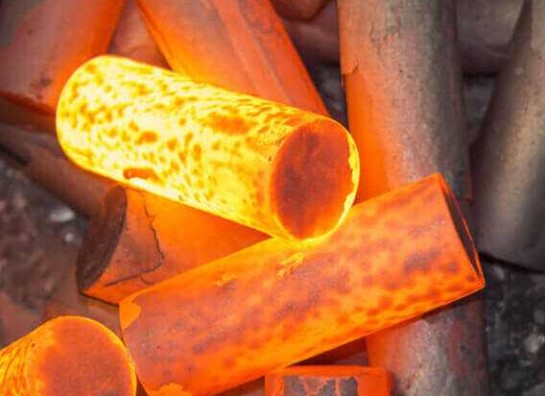
Different materials exhibit significantly different temperature stress evolution paths, primarily determined by their deformation resistance.
Soft steel forgings, such as low-carbon steel, have low deformation resistance and good plasticity. During the initial cooling stage, tensile stress generated in the surface layer can be released through localized plastic deformation, resulting in relatively low stress magnitude. As cooling continues into the later stage, surface temperature decreases substantially and volumetric contraction nearly stops. However, the core temperature remains relatively high and continues to contract but is constrained by the already hardened surface layer.
At this point, the stress direction reverses: the surface layer changes from tensile stress to compressive stress, while the core changes from compressive stress to tensile stress.
This stress reversal is particularly important for soft steel forgings. Since the final stress state is characterized by tensile stress in the core and compressive stress on the surface, cracks, if they occur, usually initiate in the core and propagate outward, forming what is known as internal cracking.
Hard steel forgings, such as high-carbon steel and alloy steel, exhibit completely different behavior. These materials have high deformation resistance and are difficult to plastically deform. During early cooling, surface tensile stress cannot be relaxed through deformation and thus remains relatively high. In the later cooling stage, although core contraction generates additional compressive stress on the surface, it only reduces surface tensile stress without reversing the stress direction. The final stress state still presents tensile stress on the surface and compressive stress in the core.
Therefore, crack risk in hard steel forgings is mainly concentrated on the surface, where external cracking may occur. Such cracks usually initiate at the surface and propagate inward, making them visually detectable and relatively easier to inspect.
It should be noted that temperature stress during cooling exists in a three-dimensional stress state, consisting of three mutually perpendicular stress components. Among them, axial stress (along the longitudinal direction of the forging) is the largest and is the primary cause of longitudinal cracking. Therefore, when designing cooling processes, special attention must be paid to the longitudinal direction of the forging, and appropriate supporting and protective measures should be implemented.
When solid-state phase transformation occurs during forging cooling, another type of internal stress is generated in addition to temperature stress—microstructural stress. This stress arises from mechanisms similar to temperature stress in that it is caused by asynchronous internal and external transformations. However, the fundamental cause is different. Microstructural stress originates from changes in specific volume before and after phase transformation, as well as differences in transformation timing between the surface layer and the core.
Common phase transformations in steel during cooling include austenite to pearlite, austenite to bainite, and austenite to martensite transformations. Among these, martensitic transformation causes the most significant volumetric expansion and generates the highest structural stress, making it a primary concern in industrial production.
Taking martensitic transformation as an example, the formation process of structural stress can be analyzed as follows:
As temperature decreases, the surface layer of the forging first reaches the martensite start temperature (Ms point) and begins transformation. Since the specific volume of martensite (0.127–0.131 cm³/g) is significantly larger than that of austenite, volume expansion occurs in the surface layer. At this time, the core temperature remains high and the material is still in the austenitic state without transformation. The core constrains the expansion of the surface layer, resulting in compressive stress on the surface (restricted expansion) and tensile stress in the core (stretched deformation).
Fortunately, the core remains at a relatively high temperature at this stage, and austenite possesses good plasticity, allowing stress relaxation through localized plastic deformation. Therefore, structural stress in the first stage generally does not cause cracking.
As cooling continues, the core temperature drops below the Ms point and martensitic transformation begins, accompanied by volumetric expansion. However, by this time, the surface transformation has already been completed, and the surface has formed a hard and brittle martensitic structure with little further volume change. The surface layer strongly restricts core expansion, creating a new stress state: compressive stress in the core and tensile stress on the surface.
This stage is extremely dangerous. Since the forging is already in a low-temperature elastic state with poor plasticity, structural stress cannot be released through deformation and continues to accumulate until martensitic transformation is completed. If the stress exceeds the material strength limit, cracking will occur.
It is important to note that the specific volume of all steel phases is greater than that of austenite. Whether it is pearlite, bainite, or martensite, their specific volumes exceed that of austenite. Therefore, regardless of the phase transformation type, similar structural stress patterns are generated: the region that transforms first is under compression, while the region that transforms later is under tension. The final stress state shows compressive stress in the later-transformed region and tensile stress in the earlier-transformed region.
Structural stress is also a three-dimensional stress state, but unlike temperature stress, the circumferential (hoop) stress component is the largest. This is the main reason for longitudinal cracks forming on the forging surface along the length direction. In practical production, cracks parallel to the forging axis are often observed on the surface, which are typically caused by structural stress.
Residual stress is the internal stress "left behind" during the forming process. During forging, metal undergoes plastic deformation, but due to non-uniform deformation—such as uneven deformation distribution, differences in deformation speed, and frictional conditions—as well as work hardening effects, internal stresses are generated.
If these stresses are not eliminated through timely recrystallization softening (microstructure recovery at high temperature) during forging, they will remain as residual stress after forging. The distribution of residual stress depends on the specific deformation conditions. It may appear as tensile stress on the surface and compressive stress in the core, or vice versa, forming a complex stress distribution pattern.
Unlike temperature stress and structural stress, residual stress already exists before the cooling process begins. It does not follow a clear evolution pattern like the other two types of stress but acts as a background stress superimposed on them. Although residual stress alone may not immediately cause cracking, it reduces the load-bearing capacity of the forging, affects dimensional stability, and may combine with other stresses during subsequent processing or service, becoming a potential crack initiation source.
The three types of internal stresses do not exist independently but interact and superimpose during the cooling process, jointly determining the quality of the forging. When their resultant force exceeds the material strength limit, cracking becomes inevitable. Therefore, understanding the superposition mechanism of these stresses is the key to developing effective prevention measures.
In actual cooling processes, temperature stress, structural stress, and residual stress are superimposed to form the total internal stress inside the forging. These stresses may reinforce each other (additive effect) or partially cancel each other (subtractive effect), depending on the cooling stage and material properties.
When the combined stress exceeds the material strength limit at a given temperature, cracks will form in the corresponding region. Since the material is in a low-temperature brittle state during the late cooling stage and has insufficient plastic deformation reserve, even a temporary exceedance of the strength threshold may cause irreversible cracking damage.
Based on the above analysis, the following general rules can be summarized:
For soft steel forgings, temperature stress is relatively small during the initial cooling stage and may reverse direction later. Structural stress tends to dominate. Since the final stress state usually features tensile stress in the core, internal cracking is more likely to occur. Internal cracks are difficult to detect and pose greater safety risks.
For hard steel forgings, temperature stress remains tensile on the surface throughout the cooling process. When combined with structural stress, which also results in surface tensile stress, stress levels on the surface become significantly higher, increasing the risk of surface cracking. Although surface cracks are visible and easier to detect, they may still lead to serious surface quality degradation and stress concentration problems.
Different cooling strategies should be adopted for different types of forgings.
For soft steel forgings, prevention of internal cracking is the primary objective. Relatively slow cooling methods should be adopted to reduce temperature gradients and temperature stress. Meanwhile, cooling rates should be controlled to ensure more uniform phase transformation and reduce peak structural stress.
For hard steel forgings, prevention of surface cracking is more important. Surface cooling rate should be carefully controlled by employing preheating, insulation, or staged cooling processes to prevent premature entry into brittle temperature ranges. For high-alloy steels, isothermal transformation or controlled cooling paths may be adopted to avoid the severe temperature zone associated with martensitic transformation.
General measures include optimizing forging structural design to avoid sudden cross-sectional changes, improving deformation uniformity to reduce residual stress, selecting appropriate cooling media (such as air cooling, pit cooling, furnace cooling, or controlled cooling), and applying intermediate holding or stepwise cooling processes for large forgings.
Internal stress control during forging cooling is a comprehensive technology involving heat transfer, materials science, and mechanics. The interaction of temperature stress, structural stress, and residual stress jointly determines the final quality state of the forging. Understanding their formation mechanisms, evolution laws, and superposition effects is the foundation for developing scientifically optimized cooling processes.
In practical production, engineers should select appropriate cooling methods and process parameters based on material characteristics, cross-sectional dimensions, and geometric complexity of the forging, keeping internal stress within a safe range to ensure product quality, improve production efficiency, and reduce manufacturing costs. Only by paying sufficient attention to the cooling stage can high-quality and efficient forging production truly be achieved.
