Copper Forging T2

To Be Your Right Partner

Copper Forging or Brass Forging is the forging process utilizing copper or brass as the forging material.
Copper alloys have good plasticity and strength, good abrasion resistance and thermal conductivity, especially good corrosion resistance in air and sea water. It has been widely used in electric power, instruments, ships and other industrial sectors.
Most copper alloys have good plasticity at room temperature and high temperature, and can be forged smoothly. Even in the presence of tensile stress, they still have enough plasticity. A few tin-phosphorous bronze with high quality fraction of tin (such as qsn7-0.2) and lead brass with high quality fraction of lead (such as hpb59-1 and hpb64-2) have low plasticity and are sensitive to tensile stress. Qsn7-0.2 is a single-phase invariant solution at room temperature when deformation occurs under static tensile stress. Has the very high plasticity, can undertake cold deformation, but plasticity under high temperature is very low, the reason is that have low melting (alpha + delta + CU3P) eutectic at high temperature.
Most copper alloys are not sensitive to deformation speed and can be forged on a press or hammer, but it is advisable to forge on a press. The phenomenon of heat effect is obvious when tin-phosphor-bronze and manganese bronze are forged. If the deformation speed is too fast, it is easy to overheat or even overheat due to the thermal effect.
When the heating temperature is too high, the copper alloy grain grew up rapidly, reduce its plasticity, so the heating temperature of copper alloy are not more than 900 ℃. When the deformation temperature is below 650 ℃, the deformation resistance increases quickly.
Like steel forgings and aluminum forgings, copper forgings in CT Forge are operated under hot forging condition as well. Below are the main steps of hot forging process of cooper alloys in our company:
Rod Cutting
Before forging, we will first order cooper bars with the right specification (such as Φ30mm) from the material factory. When they are in stock, to insure filling the die cavity during forging, billets will be cut to a certain length according to the dimensions of final cooper forgings.
Heating
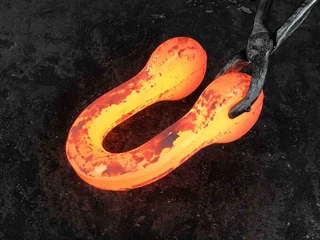
Since the billet will be forged under hot condition, the billets are then heated to a certain forging temperature. To insure a quality part, the forger must carefully control the billet temperature, as too cold the billet will not fill the die cavity completely whereas too hot it will result in a porous surface.
Forging
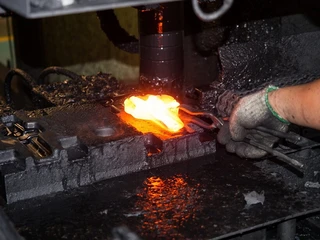
The dies are heated to insure proper metal flow, and the heated billet is placed in the lower half of the die cavity. With a downward stroke of the forging ram, the upper die is forced against the billet to form the desired shape. Since copper and copper alloys are readily forged, most commercial forgings are produced with a single closing of the press, no re-strike or reheating being required. This permits the use of single cavity dies rather than the more expensive progressive dies required by hard-to-forge materials, and reduces labor costs, die costs, and heating costs.
Forging rates vary between 100 and 1,200 pieces per hour with the majority of forgings being forged at 200 to 600 piece rates. Where quantities are large and the design is simple, considerable savings result from the use of multiple cavity dies, with more than one part being produced at a time.
It is during this process that the dense grain structure of the hot wrought extruded brass rod is further hot worked to assure a dense uniform product with excellent physical and mechanical properties. These superior properties frequently permit the use of forged parts which are lighter than those produced by other processes.
Trimming
To insure complete filling of the die cavity, the weight of the forged copper part slightly exceeds that required by the finished forging. To allow for this excess metal, a gutter or relief area is provided in the die surface surrounding the die cavity. During forging, the excess metal is extruded into the gutter as overflow or flash which is removed later in a trimming operation. Good forging die design keeps the amount of flash to a minimum for minimum scrap. Since the flash thickness varies with the ram pressure on the die, the amount of excess metal, the billet temperature when forged, and the die temperature, the flash thickness dimension customarily has twice the tolerance allowed for other dimensions of the part. Where tighter outside dimensions are specified, a close trimming operation known as shaving can be substituted.
Dip Finishing
During the forging process surface oxides form and the parts are coated with lubricants picked up from the dies. Both these surface layers are dissolved by dipping the parts in a series of special solutions. After the forgings are clean, they are generally dipped in a passivating bath to insure a clean surface for subsequent handling.
Due to the stringent requirements of the Environmental Protection Agency, some forging suppliers have substituted a steel ball tumbling operation for dipping to clean cooper forgings.