
In modern industry, flanges are critical components widely used in electrical engineering, fire protection systems, HVAC installations, and many other fields. Their primary function is to connect pipelines, ensuring structural strength, sealing integrity, and ease of installation and disassembly. High-quality flange manufacturing is essential to guarantee the stable and safe operation of entire piping systems. As a traditional forging method, open-die forging continues to play an irreplaceable role in flange production. This article provides an in-depth discussion of the open-die forging process for flanges, key quality control points, and optimization measures, aiming to help readers gain a comprehensive understanding of the fundamentals and value of flange open-die forging.
Open-die forging of flanges is a forming method in which metal is forged using simple tools and open dies (anvils). Compared with closed-die forging, open-die forging employs general-purpose tools and dies, offering advantages such as high flexibility, low cost, and short production preparation cycles. It is particularly suitable for single-piece and small-batch production. However, it also has drawbacks, including low productivity, high labor intensity, lower dimensional accuracy, and larger machining allowances. Despite these limitations, open-die forging remains the primary production method for large forgings and occupies an important position in industries such as heavy metallurgical machinery, power machinery, mining machinery, crushing equipment, forging machinery, shipbuilding, and locomotive manufacturing.
Open-die forging can be divided into manual forging and machine open-die forging. Manual forging is the simplest form, in which metal is shaped by hand hammering. As an ancient forging process, it still exists in some sporadic repair work or agricultural tool accessory industries, but it is gradually being phased out. Machine open-die forging is carried out on forging hammers or hydraulic presses. In hammer forging, the metal deforms rapidly and can maintain forging temperature for a relatively long time, which is conducive to forming the required shape. Rolled or pre-forged steel is commonly used as the billet, and this method is mainly applied to small-batch production of small- and medium-sized forgings. In contrast, open-die forging on hydraulic presses features a slower deformation rate, allowing deformation to penetrate deeply into the billet. It is mainly used for breaking down steel ingots and producing large forgings (several tons or more), such as cold and hot rolling rolls, low-speed high-power diesel engine crankshafts, turbine generators and turbine rotors, pressure vessel shells and flanges for nuclear power plants, with forging weights reaching up to 250 tons.
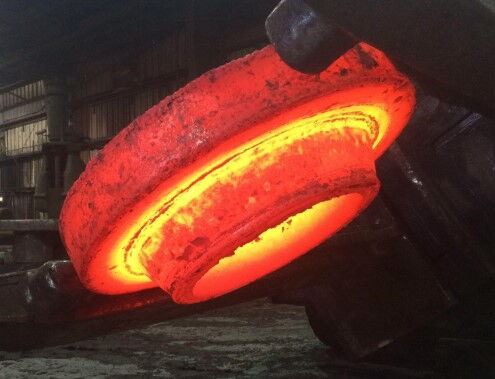
The open-die forging process for flanges mainly includes the following key steps:
Cutting is the first step in open-die forging of flanges. A small section of bar stock is usually selected for cutting and forging. During cutting, the billet length must meet standard requirements to avoid irregular fracture surfaces. Gas cutting is commonly used for flange forgings to ensure flat and smooth cross-sections and end faces. After cutting, the billet end faces and sections must be flat and free from impurities to ensure the quality of subsequent forging operations.
Heating is a crucial step in the forging process. Flange billets are typically heated in a furnace. During heating, temperature, heating rate, and soaking time must be carefully controlled. The forging exit temperature should be considered, and furnace process parameters should be scientifically designed to ensure accurate temperature control. Excessively high temperatures will reduce the plasticity index of the forging, while excessively low temperatures will fail to guarantee the quality required for flange applications. At the same time, decarburization must be controlled, as it can increase cross-sectional dimensions and reduce thermal conductivity. Heating and soaking times should not be excessively long; otherwise, uneven stress and thermal effects may occur, leading to cracks in the flange billet.
Upsetting is an important step in open-die forging of flanges. Before upsetting, the billet is placed on the workbench with its axis perpendicular to the forging surface, and piercing is carried out. During upsetting, the height-to-diameter ratio of the billet must not exceed 2. As the height decreases, the diameter increases accordingly. After piercing, the core is drawn out to ensure flat billet end faces. If piercing deviation occurs, the inner wall thickness and height must be increased and the piercing operation repeated to avoid the formation of horseshoe-shaped end faces.
Core drawing involves elongating the billet core and expanding the hole using a mandrel to increase the inner diameter of the billet. During elongation, operators should rely on production experience and the material flow behavior of the billet, flexibly controlling shape and dimensions by adjusting the reduction amount and rotating the billet at appropriate angles. Common defects include non-parallel end faces and uneven wall thickness. Therefore, it is essential to ensure that both end faces are level, surfaces are smooth, and dimensions comply with drawing requirements.
Hole expansion is another critical step in open-die forging of flanges. First, a mandrel with an appropriate diameter and a suitable anvil spacing should be selected according to the inner hole size. During hole expansion, the reduction must be uniform, the rotation angle appropriate, and material flow at both ends synchronized. When approaching drawing dimensions, small reductions should be applied to ensure proper overlap between hammer blows, avoiding missed blows. This ensures smooth forging surfaces while maintaining efficiency.
However, small reductions may make surface scale difficult to remove. If scale is not thoroughly removed, it may be pressed back into the billet, significantly reducing surface quality. Therefore, before forging, measures such as regularly replacing furnace pads, controlling billet heating time, and rotating the billet with the hammer head should be taken to remove surface scale. For internal scale, the mandrel can be used for removal.
Quality control in open-die forging of flanges is critical to ensuring final product quality. Every stage of the forging process must be strictly controlled to ensure that strength, sealing performance, and dimensional accuracy meet design requirements.
The quality of the billet directly affects the quality of the final forging. During cutting, billet length must meet standards, and end faces and sections must be flat and free from impurities. During heating, temperature, heating rate, and soaking time must be controlled to prevent decarburization. At the same time, billet microstructure and properties should be improved by breaking columnar grains, eliminating segregation, and welding internal porosity, thereby increasing material density.
The rationality of the forging process is key to ensuring flange forging quality. According to the forging sequence, production lines should be reasonably arranged, and the processes for billet preparation, cutting, machining, and heat treatment should be optimized to improve flange quality. During forging, decarburization must be controlled, uneven stress avoided, and dimensional accuracy and surface quality ensured.
Heat treatment is an indispensable part of open-die forging for flanges. Through appropriate heat treatment processes, the microstructure and properties of forgings can be improved, including grain refinement, grain uniformity, and enhancement of tensile strength, fatigue strength, and impact toughness. Heat treatment also ensures the required hardness, wear resistance, and overall mechanical performance. During heat treatment, temperature, time, and cooling rate must be strictly controlled to achieve the desired results.
To improve quality and production efficiency, the following optimization measures can be adopted:
Based on existing processes, billet quality should be improved to enhance forging performance. High-quality raw materials should be selected, cutting processes optimized, and billet dimensional accuracy and surface quality ensured. Proper heating processes should be applied to control billet temperature and heating time, prevent decarburization, and improve microstructure and properties.
Production lines should be reasonably arranged according to forging sequences, and processes for billet preparation, cutting, machining, and heat treatment optimized to enhance flange quality. During forging, process parameters such as reduction amount and rotation angle should be flexibly adjusted according to billet shape and size to ensure dimensional accuracy and surface quality.
Strict quality inspection and control should be implemented at every stage of forging. Advanced inspection equipment and techniques should be used to examine billet and forging dimensions, shapes, surface quality, and internal defects, enabling timely identification and correction of quality issues. A sound quality management system should be established to record and analyze quality problems and continuously optimize forging processes and operating procedures.
Open-die forging of flanges is a traditional forging process that continues to play an important role in modern industry. Through the appropriate use of forging processes and parameters, it is possible to improve raw material microstructure and properties while shaping the billet, thereby enhancing forging quality. However, open-die forging also has inherent disadvantages, such as low productivity, high labor intensity, and limited dimensional accuracy. Therefore, to improve quality and production efficiency, it is essential to continuously optimize forging processes, strengthen quality inspection and control, and implement effective measures to address issues arising during forging. Only in this way can the quality of flange forgings be ensured to meet the high demands of modern industry.
