
In modern industrial production, copper and its alloys are widely used across various fields, including electrical, electronics, automotive, and aerospace, due to their excellent electrical conductivity, thermal conductivity, and machinability. However, transforming raw copper materials into the required parts and products relies heavily on specialized metalworking processes. Among these, copper forging and copper die casting are two of the most important and widely applied processing methods.
For many professionals who are new to the metalworking industry, or for companies that need to procure copper parts, these two processes are often confusing: what exactly is the difference between them? Which type of product is each suitable for? How should production costs and product quality be balanced? From a practical production perspective, this article systematically introduces the complete process flow, technical features, advantages and disadvantages, and application scenarios of copper forging and copper die casting in plain and easy-to-understand language, helping readers fully understand these two important copper processing methods and providing valuable references for actual production and procurement decisions.
Copper forging is a metalworking process that uses pressure to induce plastic deformation in copper materials. Simply put, it involves using molds and forging equipment to "press" copper into the desired shape. This process is similar to blacksmithing, but uses copper as the material. Copper is suitable for forging mainly due to its excellent ductility and malleability. When heated, copper becomes soft like dough and can be shaped into various forms. Among all copper alloys, brass is the easiest material for hot forging, typically containing 38% zinc, a small amount of lead, and copper.
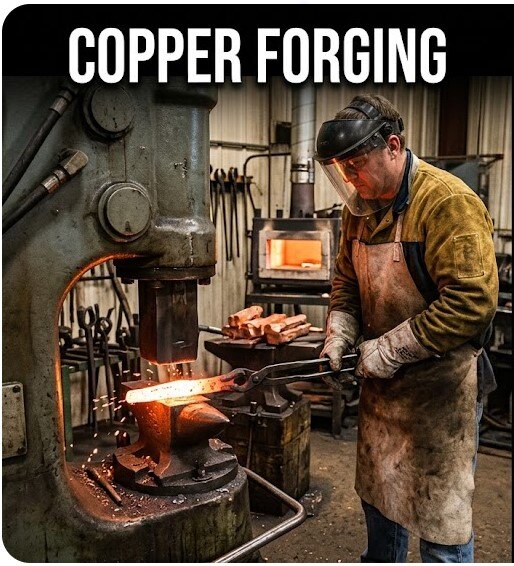
Before forging begins, technicians need to design and manufacture forging dies or tooling according to the product design drawings. The accuracy of the mold directly determines the dimensional precision and surface quality of the final product. Although this step occurs before formal production, it serves as the foundation of the entire process.
The first step in manufacturing copper forgings is selecting high-quality raw materials. Typically, high-purity copper with a purity of over 99.9% is used to ensure that the forged components have excellent electrical and thermal conductivity. Raw copper is generally supplied in the form of rods, bars, or billets, and cut to appropriate lengths according to design requirements. The purity and compositional uniformity of the raw material are fundamental to ensuring the performance of the final forged product, as any impurity may result in defects.
The cut copper billets are placed in a high-temperature furnace and heated to 800–900°C. This temperature range allows copper to reach an ideal plastic state, neither too hard to deform nor too soft to lose strength. Precise temperature control is essential, as overheating may burn the material, while underheating results in insufficient plasticity.
The heated copper billets are quickly transferred to the forging dies, where uniform pressure is applied using forging equipment, causing the copper to plastically deform and gradually form the required shape and dimensions. Multiple forging passes are usually necessary to ensure a dense internal structure without pores or defects. During forging, the internal grain structure of copper is optimized, significantly improving mechanical properties.
The formed copper forgings need to be cooled, commonly by air or water. The cooling rate and method significantly influence the grain structure and mechanical properties of copper, directly affecting the strength, toughness, and ductility of the forgings. Different cooling methods produce different material characteristics, which should be selected according to the final application.
Cooled forgings require deburring and surface finishing through methods such as sandblasting, making the product closer to the final design dimensions and appearance requirements. This stage includes removing burrs, grinding smooth, polishing, and applying necessary coatings to improve appearance, corrosion resistance, and surface hardness.
Heat treatment is a key step in copper forging. Through solution treatment and annealing, alloy elements can be homogenized, grain structure optimized, and mechanical properties improved. The process includes:
Initial heat treatment to dissolve residual alloy elements and form a uniform phase structure.
Quenching to lock in the microstructure.
Low-temperature aging or tempering to enhance strength and toughness.
The heat treatment parameters can be adjusted according to the intended use of the copper forgings to balance strength and ductility requirements.
After manufacturing, copper forgings must undergo strict inspection and testing. Non-destructive testing methods, such as ultrasonic, radiographic, or magnetic particle inspection, can effectively detect internal cracks, pores, and other defects. Destructive testing, including tensile, impact, and hardness tests, evaluates mechanical performance. Visual inspection checks surface defects and dimensional errors, ensuring that the forgings meet design requirements and industry standards. Only copper forgings that pass all inspections are released for delivery.
Copper alloys can be forged using hot or cold methods. Hot forging is performed at high temperatures and is suitable for manufacturing components of various sizes due to better material flow and lower deformation resistance. Cold forging, performed at room temperature, is suitable for small components. Cold forging improves the strength of the forgings and allows high-precision machining but significantly reduces ductility. However, annealing can restore ductility, although strength decreases correspondingly.
Copper die casting is a precision casting process in which molten copper or copper alloys are injected into a mold cavity under high pressure and rapidly cooled to form. This process combines high-pressure casting technology with the unique advantages of copper, enabling the production of high-precision, high-performance parts, especially for complex shapes.
It is important to note that not all die-cast products use pure copper because copper alloys often provide additional advantages in castability and mechanical performance. Pure copper is rarely used for die casting due to its tendency to develop cracks, shrinkage, and porosity.
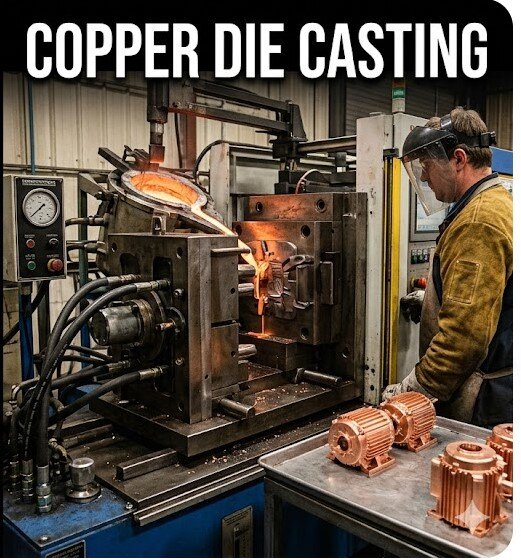
- Brass: An alloy of copper and zinc, offering good corrosion resistance, machinability, and formability. Widely used in marine, industrial, and consumer products. Brass is often used in applications requiring good acoustic properties, such as musical instruments.
- Bronze: An alloy of copper and tin, with high density, corrosion resistance, and tensile strength close to steel. Suitable for wear-resistant and load-bearing components, such as cams, thrust plates, and washers. Bronze is known for its wear resistance and widely used in heavy-duty bearings.
- Beryllium Copper: An alloy of copper and beryllium, harder than some steels, with excellent thermal conductivity, electrical conductivity, ductility, wear resistance, and corrosion resistance. Often used in aerospace and automotive components, such as pitot tubes and sensor housings.
Due to the high melting point of copper and copper alloys, cold-chamber die casting is typically used. The basic steps include:
- Mold Preparation: Clean the mold surface to ensure no impurities affect part quality.
- Melting: Melt the copper alloy in a high-temperature furnace, with precise temperature control.
- Injection: Pour molten copper into the unheated cold chamber and use high pressure to rapidly inject it into the mold cavity.
- Holding and Cooling: Keep the mold closed and maintain pressure until the copper solidifies, ensuring part density.
- Extraction and Finishing: Remove the die-cast parts from the mold, trim gates and runners, and recycle excess material.
Porosity is the most common quality problem in copper die casting, referring to tiny cavities within the casting that can affect mechanical performance, durability, and appearance. Porosity can be classified into micro-porosity and macro-porosity:
- Micro-porosity: Small interconnected cavities, invisible to the naked eye, but reduce material integrity.
- Macro-porosity: Larger cavities, visible to the naked eye, which significantly affect strength and aesthetics.
Methods to Reduce Porosity:
- Process optimization: Adjust injection pressure and speed, reduce turbulence, and implement degassing to remove hydrogen in molten copper.
- Mold design optimization: Improve venting systems to ensure gas can escape during injection, and use computational fluid dynamics to optimize cooling channel layout for uniform cooling.
- Material treatment: Use high-purity copper alloys, strictly control moisture, and apply grain refiners to promote uniform solidification and reduce shrinkage porosity.
Before delving into the detailed process flows of copper forging and copper die casting, let us first compare and analyze the core advantages and disadvantages of copper die casting, helping you quickly determine whether this process is suitable for your production needs.
- Strong capability for producing complex parts: Unlike CNC machining, extrusion, or stamping, die casting can form complex parts in one production cycle, reducing processing steps.
- Suitable for large-scale production: High automation, high production efficiency, low labor costs, stable part quality, and the ability to produce large quantities quickly.
- High precision: Tight tolerances and high surface quality ensure parts fit usage requirements without additional adjustment.
- Integrated production: Reliable and efficient for complex shapes and fine structures.
- Porosity issues: Rapid filling of the mold can trap air, affecting strength and integrity.
- Not suitable for low-volume production: High initial mold and equipment cost makes small batch production expensive.
- Short mold life: Repeated exposure to high-temperature molten copper weakens mold structure, increasing maintenance and replacement costs.
- Copper Forgings: Excellent mechanical properties, dense internal structure, and fine, uniform grains. Further optimization of strength and toughness possible through heat treatment. Good electrical and thermal conductivity, excellent corrosion resistance. Suitable for applications requiring high-performance materials.
- Copper Die Castings: Excellent in electrical applications, durability, and machining precision. High conductivity makes it ideal for efficient energy transfer in electrical systems. Good thermal conductivity ensures effective heat dissipation and stable operation. Corrosion and wear resistance make die-cast parts durable in harsh environments. High precision and detail reproduction ensure tight tolerances and high surface quality.
The choice depends on:
- Production volume: High-volume production favors die casting; low-volume or single-piece production favors forging.
- Part complexity: Complex shapes favor die casting; simpler shapes can use either process.
- Performance requirements: High mechanical performance favors forging; high dimensional precision can be achieved by both.
- Cost considerations: Die casting requires high initial investment but lowers unit cost for large batches; forging equipment investment is lower, suitable for small, varied batches.
Copper forging and copper die casting are two important processing methods, each with its characteristics and applications. Forging produces dense internal structures and excellent mechanical properties, suitable for strength-critical applications. Die casting enables high-precision production of complex shapes, ideal for large-scale production.
Regardless of the chosen process, raw material selection, process parameter control, heat treatment, and strict quality inspection are key to ensuring product quality. Copper forging not only tests metal plastic deformation techniques but also integrates materials science and process control. Through proper raw material selection, precise forging techniques, scientific heat treatment, and rigorous inspection, copper forgings and die-cast parts can meet the diverse needs of industries such as construction, power, automotive, and electronics while ensuring high performance, precision, and durability.
