
High-temperature alloy forgings are essential advanced materials in modern industry and are widely used in extreme operating environments such as aero engines, spacecraft, and petrochemical equipment. These materials must maintain excellent strength, creep resistance, and corrosion resistance at temperatures ranging from 600°C to 1200°C. As a result, their manufacturing process is far more complex than that of ordinary steels. This article focuses on the core technical challenges in high-temperature alloy forging and systematically discusses key processes including heating control, deformation resistance breakthrough, microstructure regulation, and advanced manufacturing methods.
The primary difficulty in high-temperature alloy forging lies in the precise control of the heating stage. Compared with carbon steel, high-temperature alloys exhibit poor thermal conductivity. If conventional heating methods are used, excessive temperature differences between the surface and the interior of the billet may easily occur, generating severe thermal stress and ultimately leading to cracking and scrapping.
To address this challenge, the industry generally adopts a stepwise heating process. Specifically, the billet is gradually heated from room temperature at a rate of approximately 5–10°C per minute until the temperature exceeds 1200°C. This slow heating process, combined with real-time monitoring using infrared temperature measurement technology, can strictly control the temperature difference within ±20°C across the billet.
Taking GH4145 alloy production as an example, the application of this process reduced the grain coarsening rate from 30% under traditional methods to about 5%, significantly improving material strength.
The control of holding time is equally critical and must be managed at a minute-level precision. Excessively long holding times may cause abnormal grain growth and degrade material performance, while insufficient holding time prevents uniform diffusion of alloying elements, directly affecting subsequent deformation quality. Such stringent time requirements reflect the high level of precision required in high-temperature alloy manufacturing.
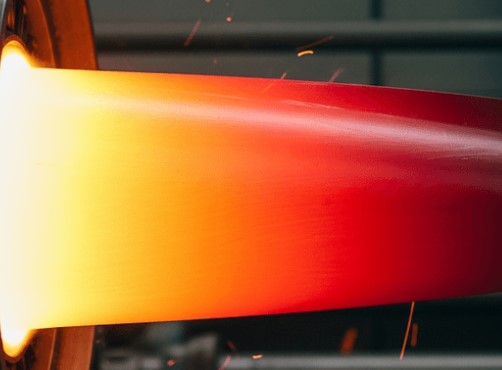
High-temperature alloys exhibit extremely high deformation resistance. While ordinary steels can be formed under 1000-ton press pressure, high-temperature alloys often require multi-thousand-ton hydraulic presses to achieve effective plastic deformation. This characteristic poses significant challenges to equipment capability and process design.
Isothermal forging technology provides an effective solution to this problem. The “two-pass ring rolling” process adopted in patent technologies represents a typical example. In the first pass, upsetting and punching operations are used to form a pre-shaped billet. In the second pass, final forming is completed under conditions where the die temperature is close to the billet temperature, with the temperature difference controlled within ±15°C.
This method increases the reduction of cross-sectional area of GH4145 alloy to 44%, achieves a tensile strength of 1268 MPa, and reduces energy consumption by 15%.
The application of die preheating technology effectively suppresses surface chilling effects, increasing the qualification rate of thin-walled components from 65% to 88%. This refined control of temperature and stress fields reflects the transformation of modern forging technology from experience-based operation to scientific precision manufacturing.
Microstructure regulation represents the ultimate objective of forging technology and directly determines the final service performance of high-temperature alloys. Controlling dynamic recrystallization to refine grain size is a core approach to improving high-temperature performance.
Taking aero-engine turbine discs as an example, multi-pass forging of 3–5 heats is usually adopted during manufacturing. Deformation energy is gradually accumulated to fully break down the coarse dendritic structure in the original casting, ultimately forming an equiaxed grain structure with an average grain size not exceeding grade 5.
In the forging of DD6 single-crystal turbine blades, a “high-temperature deformation followed by rapid cooling” process is used to achieve more uniform carbide distribution along grain boundaries, extending blade service life by approximately 20%.
For powder metallurgy high-temperature alloys, the combination of hot isostatic pressing and multi-directional forging is required to eliminate particle boundaries and ensure density levels above 99.5%. This pursuit of microscopic structural perfection reflects the core philosophy that “details determine success” in high-end manufacturing.
High-temperature alloys possess high alloying degrees and multiphase complex structures, resulting in relatively low process plasticity. In particular, impurities such as sulfur, lead, and tin may weaken intergranular bonding at high temperatures and further reduce plasticity.
The total content of strengthening elements such as aluminum and titanium is commonly used as an indicator of alloy plasticity. When the combined aluminum and titanium content reaches or exceeds 6%, the material plasticity becomes very low. The process plasticity of nickel-based high-temperature alloys is generally lower than that of iron-based high-temperature alloys.
Such plasticity is highly sensitive to deformation speed and stress state. Some alloy ingots and intermediate billets must be formed using special processes such as low-speed deformation, canned upsetting, canned rolling, or even canned extrusion.
Due to complex compositions, high-temperature alloys exhibit high recrystallization temperatures and slow recrystallization rates. During deformation, they show high deformation resistance and work-hardening tendencies. Their deformation resistance is typically 4–7 times that of ordinary structural steel.
Compared with carbon steel, high-temperature alloys also have lower melting points. Excessively high heating temperatures may cause overheating or burning, while stopping forging at too low a temperature reduces plasticity and increases deformation resistance, often leading to mixed hot-and-cold deformation and coarse grain formation. Therefore, the forging temperature range of high-temperature alloys is very narrow, usually about 200°C, and for nickel-based heat-resistant alloys it is even narrower, mostly within 100–150°C, and sometimes less than 100°C.
In addition, the thermal conductivity of high-temperature alloy forgings at low temperatures is much lower than that of carbon steel. In the temperature range of 700–800°C, slow preheating is required; otherwise, large thermal stresses may occur, placing the metal in a brittle state and increasing the risk of cracking.
In response to the special characteristics of high-temperature alloys, multiple forging methods have been developed in industry, each with its own applicable scope and characteristics.
Traditional forging methods include free forging and die forging. Free forging shapes metal materials through manual or mechanical hammering, while die forging forms materials within a forging die to maintain specific geometries during compression. These methods are characterized by simple equipment and low cost, but have lower production efficiency and poorer quality stability.
Isothermal forging is carried out under constant temperature conditions to maintain stable microstructure and uniform material properties. This method effectively reduces internal stress and improves fatigue life, making it particularly suitable for manufacturing critical components such as turbine discs and blades.
Rapid forging completes the forging process within a very short time, preventing excessive internal stress development during deformation and thereby improving forging quality. This method offers high productivity and excellent mechanical properties, making it suitable for large high-temperature alloy forgings.
Superplastic forging utilizes the superplasticity of metal materials under specific temperature and pressure conditions to achieve large deformation and enhance material performance. It is mainly used in manufacturing high-performance high-temperature alloy components.
Powder metallurgy forging first compresses and sinters metal powders to form billets, and then performs forging operations. This process effectively increases density and strength while reducing internal porosity and defects, making it suitable for producing high-performance high-temperature alloy forgings.
Composite material forging combines two or more materials into composite billets through specialized processes before forging, allowing the final forgings to possess multiple material advantages and making it suitable for manufacturing high-temperature alloy components with complex structures and performance requirements.
Manufacturing high-quality high-temperature alloy forgings requires the establishment of a comprehensive quality assurance system. The first step is material selection, where suitable high-temperature alloys must be chosen based on specific application scenarios and operating temperatures to ensure excellent high-temperature oxidation resistance, creep resistance, and corrosion resistance, while maintaining stable and reliable supply channels.
The second step involves process control, including precise management of preheating, forging pressure, forging temperature, and forging speed. Proper preheating eliminates internal stresses and reduces deformation resistance. Appropriate forging pressure and temperature ensure dimensional accuracy and consistency. Suitable forging speed helps achieve grain refinement and uniformity.
Heat treatment is a critical step in improving forging quality. Processes such as annealing, normalizing, quenching, and tempering are used to eliminate internal stresses, enhance strength and hardness, and improve heat resistance. Specific methods must be determined based on alloy type and forging size.
Finally, inspection and quality control are essential, including metallographic analysis, mechanical property testing, nondestructive testing, and ultrasonic inspection, ensuring that every production batch and every component meets design specifications and customer requirements.
High-temperature alloy forging manufacturing is a systematic engineering process involving multiple disciplines including materials science, thermodynamics, mechanical engineering, and automatic control. From precise heating control to effective breakthroughs in deformation resistance, and from microstructure refinement to the comprehensive application of digital technologies, every process link requires strict quality management. As aerospace and other high-end equipment industries continue to demand higher material performance, high-temperature alloy forging technology will continue to evolve toward precision and intelligent manufacturing, providing strong support for the transformation and upgrading of the manufacturing industry.
