Automotive Bolts and Nuts | Engine & Chassis Fasteners

To Be Your Right Partner
Automotive fasteners are essential basic components for vehicle assembly and core guarantee factors for driving safety, structural stability and service life. A complete passenger vehicle requires thousands of fasteners of different specifications, covering the power system, transmission system, chassis suspension, body structure and interior & exterior assemblies. Although small in size, they undertake positioning, locking, load-bearing and anti-vibration functions for almost all automotive parts.
Different from ordinary standard fasteners, automotive-grade fasteners feature strict mechanical grades, excellent fatigue resistance, vibration stability and environmental durability. Vehicles continuously bear vibration, impact load, temperature alternation, rain erosion and road sediment corrosion during operation. Therefore, automotive bolts, nuts and screws must undergo precise material selection, forging forming, heat treatment strengthening and professional surface protection to avoid loosening, thread slipping, fracture and rust failure.
According to vehicle application scenarios, automotive fasteners are divided into three core systems:
1.Power and Transmission System Fasteners
Used for high-temperature and high-vibration working environments such as engines and gearboxes. These fasteners withstand continuous thermal cycling and high-frequency mechanical vibration. They adopt high-strength grades of 8.8, 10.9 and 12.9, requiring extreme tensile strength and locking accuracy to prevent fatigue fracture under long-term operating conditions.
2.Chassis and Suspension System Fasteners
As core safety components, they bear road impact load and body torsion stress. Hex flange bolts and hex flange nuts are widely used in chassis brackets, suspension arms and brake systems. The integrated flange design provides larger contact area, uniform pressing force and reliable anti-loosening performance, effectively avoiding loosening caused by long-term driving vibration.
3.Body and Trim Fasteners
Mainly applied to body frames, sheet metal connection, lamps and interior decoration with medium and low load requirements. Focusing on assembly accuracy, fitting tolerance and surface integrity, these fasteners maintain overall structural stability and exterior appearance consistency.
The quality of automotive fasteners depends on four core factors: raw material, forging technology, heat treatment grade and anti-corrosion treatment. Carbon steel, alloy steel and stainless steel are mainstream materials, while lightweight alloys are increasingly adopted for new energy vehicles. Cold forging forms a compact internal grain structure for stable mechanical performance. Surface treatments such as galvanizing and Dacromet enhance corrosion and aging resistance, ensuring stable performance under diverse road and climate conditions.
With the upgrading of new energy vehicles, battery packs, electric drive and electronic control systems have raised higher standards for fastener anti-loosening performance, precision and lightweight properties. Modern automotive fasteners have evolved into high-precision industrial parts that determine vehicle safety and long-term reliability.
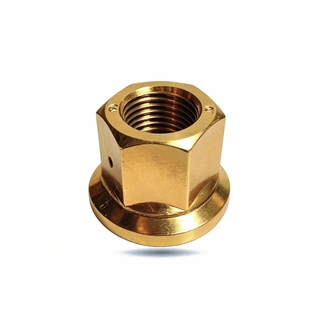
The wheel nut is a safety fastener designed to secure vehicle wheel hubs to the axle. It locks the wheel assembly firmly for reliable driving.
Subjected to continuous vibration and road impact, wheel nuts require strict strength standards to prevent loosening. Most are made of carbon steel with heat treatment, finished with yellow zinc plating for corrosion resistance. The tapered seat design helps centering and even load distribution during tightening. Wheel nuts must be torqued to specified values after tire service.