
In modern industrial manufacturing, cylinder forgings play a crucial role. Whether in nuclear power, petrochemicals, or hydroelectric energy, high-quality cylinder forgings are indispensable. These components must operate stably for extended periods under extreme conditions such as high temperature and high pressure, placing stringent demands on both materials and manufacturing processes. This article provides an in-depth exploration of the entire forging process for cylinder components, including pre-forging preparation, key technical points during cylinder forging, and subsequent processing, offering practitioners a comprehensive and practical operational guide.
Before delving into the forging stages, it is essential to start with pre-forging preparation. Though seemingly basic, this step is critical for the success of the entire forging process. Adequate preparation ensures smooth execution of subsequent forging operations and the production of high-quality cylinder forgings.
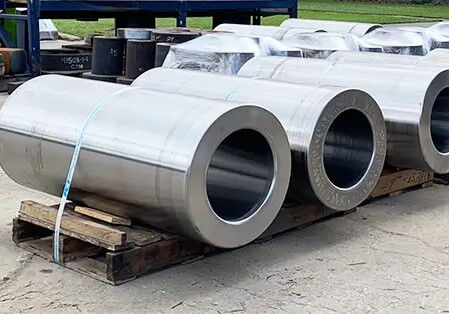
Raw materials determine the performance of cylinder forgings. Across various industries, forgings must meet stringent requirements for strength, toughness, and corrosion resistance. For instance, in the nuclear power sector, cylinder forgings must withstand complex conditions including high temperatures, high pressures, and intense radiation. Choosing alloy steels with high-temperature strength and radiation resistance is therefore essential.
Available materials include a wide range of steel grades, high-temperature alloys, and non-ferrous metals such as aluminum, magnesium, titanium, and copper. These may come as processed bars and profiles or as ingots in various specifications. Both domestically sourced materials and imported ones are used. Most materials conform to national standards, while some are newly developed or under trial. Forging operators must possess strong material knowledge and select the most suitable raw materials based on process requirements. Rigorous selection of suppliers and stringent testing of chemical composition, purity, and internal structure are necessary to ensure stable and reliable material quality.
Accurate material calculation and cutting are crucial for maximizing material utilization and refining blanks. Excess material leads to waste and accelerates die wear and energy consumption. Insufficient allowance complicates process adjustments and increases scrap rates. The quality of cut surfaces also impacts subsequent forging and final part quality.
Operators must calculate material requirements precisely based on product drawings and specifications, using appropriate cutting methods such as sawing or shearing to ensure accurate dimensions and smooth ends. This not only facilitates subsequent forging but also reduces production costs and improves efficiency.
Heating is an indispensable pre-forging step aimed at reducing deformation force and improving metal plasticity. However, it also introduces challenges such as oxidation, decarburization, overheating, and burning. Precise control of initial and final forging temperatures significantly affects the microstructure and mechanical properties of the forging.
Common heating methods include flame furnaces and induction heating. Flame furnaces are cost-effective and versatile but require longer heating times, are prone to oxidation and decarburization, and involve demanding labor conditions. Induction heating offers rapid heating with minimal oxidation but is less adaptable to variations in product shape and material. In practice, the heating method should be chosen according to product requirements and production conditions, with strict control of temperature and duration to achieve optimal forging temperature while avoiding heating defects.
After preparation, the process enters the core stage of forging. Mastery of key technical points directly influences the quality and performance of cylinder forgings. Every detail, from deformation force calculation to forging method selection, die design, and lubrication, requires precise operation and scientific decision-making.
Forging involves external force-induced shaping, so accurate calculation of deformation force is essential for selecting suitable equipment and validating dies. Stress-strain analysis of the workpiece also helps optimize the process and control material properties.
Common analysis methods include the principal stress method, slip-line method, upper bound method, and finite element method (FEM). The principal stress method is simple and intuitive, providing total pressure and stress distribution on contact surfaces. The slip-line method accurately solves planar strain problems and local stress distributions but has limited applicability. The upper bound method provides conservative load estimates and predicts shape changes during deformation. FEM can determine external load, shape changes, and internal stress-strain distribution, though it requires substantial computing resources. Hybrid approaches are increasingly used, such as rough estimation via the upper bound method followed by detailed FEM analysis at critical locations.
Accurate force calculation enables selection of appropriate forging equipment, such as hammers or presses, ensuring that the equipment meets force requirements without overloading or waste.
Forging is the core step in manufacturing cylinder components. Choosing the appropriate forging method and designing effective dies is critical to meet shape and dimensional requirements.
Common methods include open-die forging and closed-die (impression) forging. Open-die forging gradually deforms material through hammering or pressing, offering high flexibility, suitable for complex shapes and large components. Closed-die forging uses dies to shape material, achieving high dimensional accuracy and surface quality, ideal for batch production. The selection of forging methods depends on product specifications, production volume, and equipment conditions.
Die design is equally crucial. Well-designed dies ensure shape and dimensional accuracy, improve efficiency, and reduce costs. Die design must consider product shape, size, material characteristics, and forging requirements to achieve strength, rigidity, and wear resistance.
Lubrication reduces friction, saves energy, prolongs die life, and ensures uniform deformation, improving microstructure quality. The choice of lubricant depends on forging type and temperature. Glass-based lubricants are common for high-temperature and titanium alloys, water-based graphite is widely used for steel hot forging, and cold forging may require phosphate or oxalate pretreatment. Selecting appropriate lubrication methods and materials ensures smooth forging and enhances both product quality and die longevity.
Once forging is complete, cylinder components are preliminarily formed. Post-forging processing is equally important to ensure final performance and quality. This includes cooling, heat treatment, subsequent machining, and inspection to fully meet design requirements.
After forging, cylinder components must be cooled and heat-treated. Cooling stabilizes microstructure and properties, while heat treatment—such as annealing, normalizing, and quenching—relieves residual stress, improves structure, and enhances mechanical properties. Proper cooling and heat treatment extend service life and reliability. For high-strength cylinder components, quenching and tempering can achieve excellent comprehensive mechanical performance, meeting operational requirements.
After heat treatment, machining processes such as cutting, drilling, and milling are applied to achieve final shape and dimensional accuracy. Strict control over machining precision ensures conformity with design specifications. Rigorous inspection is also essential. Techniques like ultrasonic and radiographic testing detect internal defects such as cracks, pores, and inclusions, ensuring product reliability and compliance with operational standards.
Large cylinder forgings, used in critical equipment for nuclear, petrochemical, and hydroelectric industries, demand superior manufacturing and quality standards. Addressing these challenges requires technological innovation.
Large cylinder forgings are typically thick-walled, large-diameter components operating under high temperature and pressure. They integrate material, smelting, forging, welding, heat treatment, and inspection technologies. Components such as pressure vessels must endure complex pressure, temperature, and medium conditions, requiring materials with excellent ambient mechanical properties, high- and low-temperature performance, creep strength, low temper brittleness, fracture toughness, corrosion resistance, and radiation resistance. Low-carbon steels with alloying for strength are often preferred for weldability.
Performance of large cylinder forgings depends not only on chemical composition but also on grain structure. Given limitations in adjusting foreign steel compositions, improving performance focuses on achieving fine, uniform grain structures. Grain refinement occurs in three stages: initial grain refinement during smelting and casting, forging-induced refinement through large plastic deformation and recrystallization, and heat treatment refinement via repeated austenitization and cooling. Advances in smelting, forging, and heat treatment techniques continue to improve control over microstructure and performance.
Traditional forging methods face limitations in large component production. Composite forging, combining methods such as open-die and closed-die or forging and rolling, represents an important innovation. Initial open-die forging eliminates internal defects and improves structure, followed by closed-die forging for dimensional precision. In forging-rolling composites, forging prepares the blank, followed by rolling to achieve both density and efficiency. Such innovations enhance quality, performance, efficiency, and cost-effectiveness.
Cylinder forging is a complex and precise manufacturing process. From material selection, calculation and cutting, and heating to deformation force calculation, forging method selection, and lubrication, and finally to cooling, heat treatment, machining, and inspection, every step directly affects the product’s quality and performance. For large cylinder forgings, particular attention to grain structure control and technological innovation is essential to meet the demands of high-end equipment manufacturing. With continuous technological progress and growing market demand, the cylinder forging industry will advance toward higher quality, efficiency, and cost-effectiveness, supporting the upgrading of industrial manufacturing and domestic production of critical equipment.
